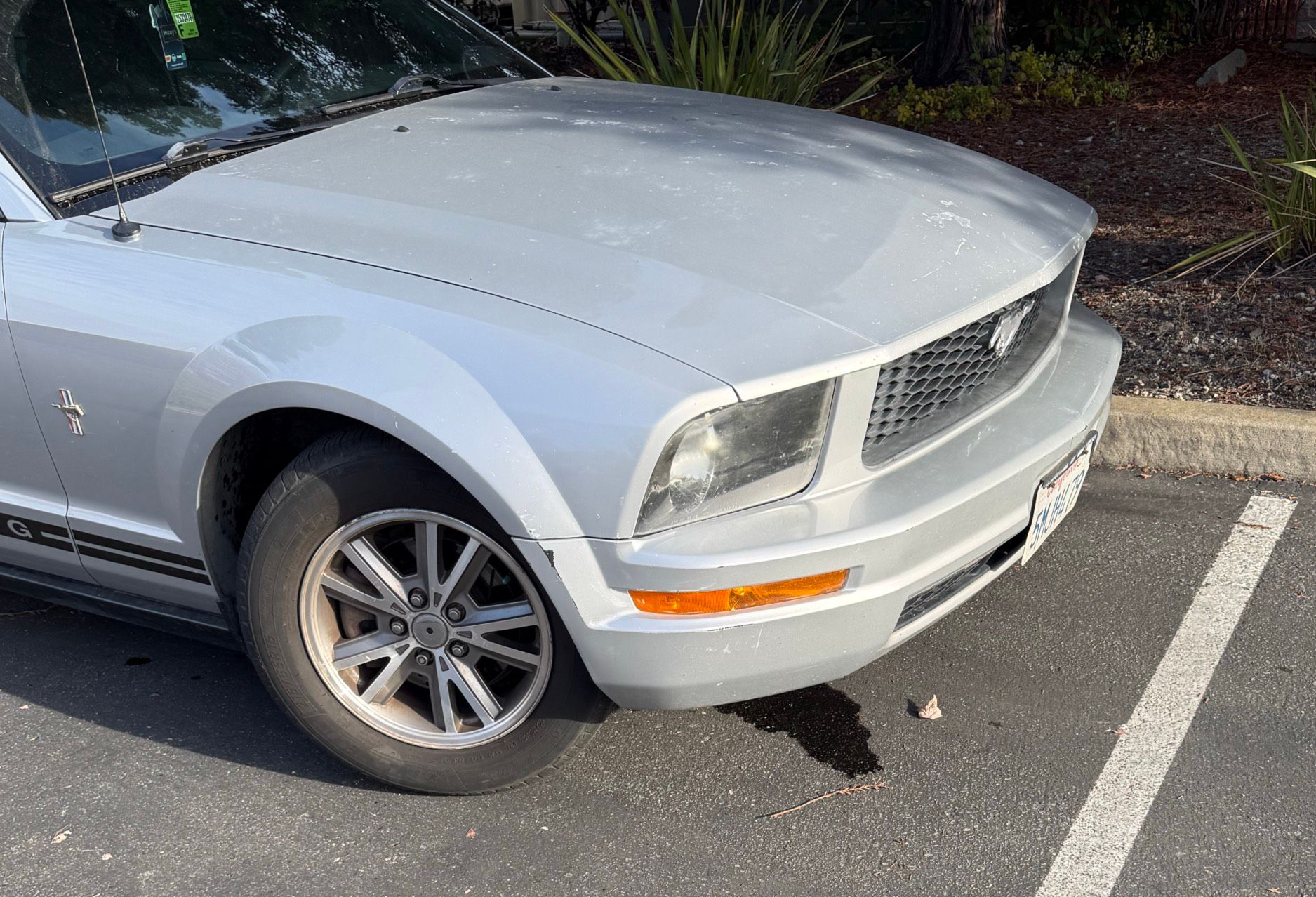
This starts with me being annoying.
Sitting in my 2005 V6 Mustang, shifted into neutral, revving the engine like a person who thinks that's fun. My wife disagrees. I continue anyway.
And then I notice something.
Around 3,000 RPM — a sound. Not a good sound. And the car won't go past it. Just hits that point and refuses.
So now I'm in the driveway, genuinely convinced something is wrong with my car.
I send it to my dad. He can't figure it out either. We go back and forth.
Then we look it up.
Rev limiter. Kicks in when you're not in gear. It's a feature.
Months without my car, worrying about a problem that didn't exist. That's how this starts.
I get it back, I'm happy, and I'm done driving the truck for daily errands.
I'm on my way to work. Traffic. And I notice what looks like smoke coming from the engine bay.
I pull over. Take a look.
Not smoke.
Steam.
I check the coolant. There's none left — completely dry. Something had been leaking long enough to drain the system entirely and I hadn't caught it.
I have class after work. I need this car today.
So I do what you do: grab a couple gallons of water, fill it, limp through the day. Class, then home.
When I get back I fill it properly.
It dumps straight out. Fast.
Whatever this leak is, it's not subtle. I'm not driving it again until I figure this out.
I get under it immediately.
I jack the car, fill it, start the engine and watch. Water is going everywhere — but finding the actual source isn't as simple as watching the puddle. Everything's wet. The water travels before it drips.
What I can tell: it's somewhere around the water pump.
Water pumps fail. It's a known thing. I feel confident.
I order the part.
Part arrives.
I get to work — and immediately discover that Ford, in their infinite wisdom, placed the water pump in a location that requires disassembling half the front of the engine to access. New tools purchased just to reach the bolts. Twelve of them.
I pull the old pump off and count the bolts I removed.
Eleven.
Twelve holes. Eleven bolts.
I feel very confident now. This was definitely it.
Except — I need new bolts before I can finish. Another delay. I run over to the hardware store the next day, because if I'm replacing one I'm replacing all of them.
New pump goes in. Even worse to install than it was to remove.
I fill it with water.
Turn the key.
Fluid everywhere.
That's a specific kind of awful.
You've done the work. You've waited. You've bled your knuckles on bolts that had no business being where they were. And the car is still leaking.
I'd already replaced the hoses preemptively. It's not there. I'm now watching coolant appear from deeper in the engine and my brain goes immediately to the worst case — head gasket, cracked block, something expensive and time-consuming and possibly not worth fixing on a 2005 V6.
And somewhere in the back of my head: a few months earlier, while my dad had the car, a spark plug blew out. Ejected clean from the head — a known problem on this engine, the threads strip and let go. He got it fixed, but I never fully stopped wondering if something deeper was off.
Now I'm staring at a fresh coolant leak that survived a water pump replacement and I'm thinking about that plug again.
I sit with it. Google it. Nothing obvious.
He just got a new tool — a smoke leak detector. You press it into an inlet, pressurize the system, and smoke finds its way out through whatever gap exists. No guessing. No chasing wet spots. The leak reveals itself.
I borrow it.
I find the leak immediately.
Thermostat housing.
The leak is there! Which — as an aside — why is a part that lives in one of the most thermally stressed areas of an engine made of plastic? I don't have a good answer. Ford apparently didn't either.
It's not as bad a job as the water pump. Nothing is as bad as the water pump.Once its out - I inspect it.
There is no visible crack, but you see water marks. Where the plastic halves of the housing showed white marks along their seam. Again - why plastic.
No leak.
I clear the codes, let it run, start driving. Happy. Smog is due in about a week, the car is running clean, everything is fine.
Then the check engine light comes on.
I sit with that for a moment.
The code is the thermostat sensor — not reading correctly. And my first thought is: I just put that part in. It might be faulty.
I go back through everything. Check the install. It's all correct. Nothing obviously wrong.
I'm about ready to blame the part when the right question finally shows up:
Did I move the connector during the job?
Yes. I had to.
I check it. The connector had failed — subtle damage, not obvious, but enough.
I order new pigtails. While I'm at it, I add heat shrink to anywhere along the harness that might flex or bend — if it failed once it can fail again, and I'd rather not come back to this.
Swap it in.
No light.
Car passes the at-home emissions test.
Job done.
The whole thing took longer than it should have. There were delays, wrong guesses, a part replaced that didn't fix it, a problem that turned out to be somewhere completely different.
What actually helped, eventually:
The right tool for the job — the smoke detector found in minutes what I'd been chasing for hours. Sometimes the block is not having the right approach, it's not having the right instrument.
Pausing when stuck — every time I stopped and came back fresh, something clicked. The connector realization didn't come from staring harder. It came from stepping back.
Not assuming the obvious answer is the right one — the water pump made sense. It was a reasonable guess. It was wrong.
The car runs fine now.
I'm still annoyed about the thermostat housing being plastic.